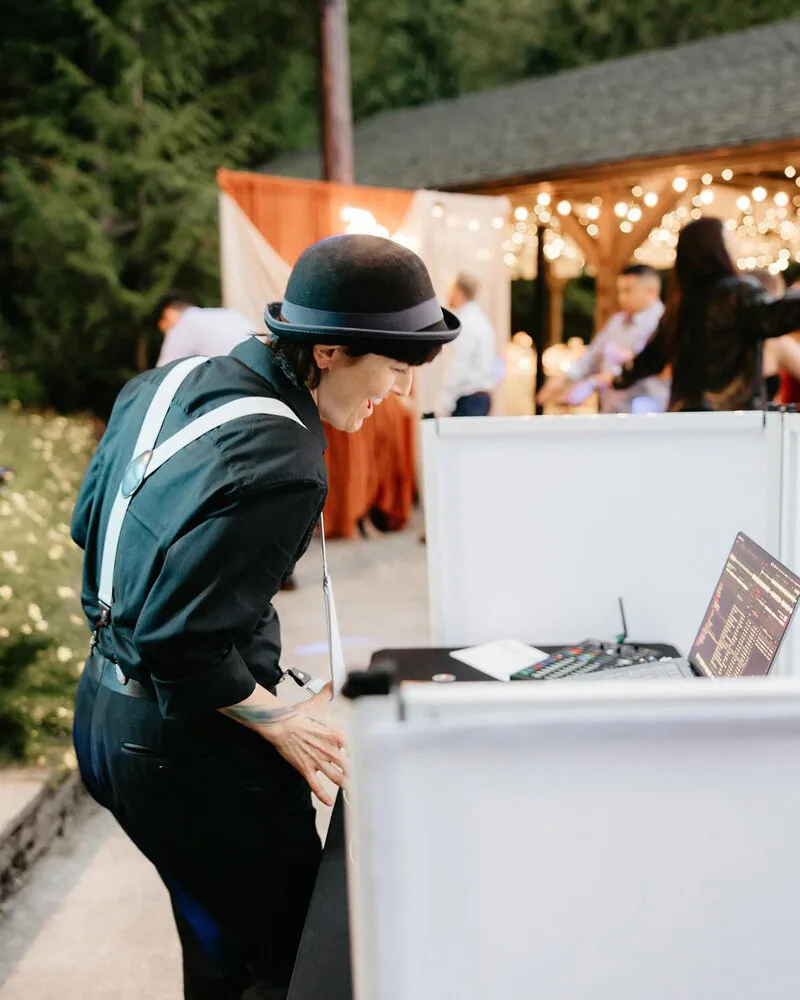
For a wedding using Haynes Hall and an outdoor ceremony area at McMenamins Anderson School in Bothell, plan the outside-to-inside transition explicitly. Your DJ needs the ceremony cues, microphone requirements, reception layout, and weather alternative, along with the order of your chosen activities.
McMenamins lists Haynes’ Hall and Haynes’ Square among its Anderson School wedding spaces. Confirm the spaces, seasonal availability, and rentals included in your own agreement.
Cover photo: Outdoor wedding ceremony at Anderson School. Photo: Emily Paris Photography
A real example: outdoor vows and an indoor reception
For an October 2025 wedding, the planning record specified a ceremony just outside Haynes Hall if weather allowed, followed by the reception indoors. Photographs from the event show the outdoor ceremony and the indoor celebration. That combination makes the transition itself an important part of the DJ plan.
Identify where guests should go after the recessional, when reception music should be ready, and who confirms that the next space is open. Also decide when a weather call will be made and how the revised ceremony location will be communicated to every vendor.
Make room for the activities that feel like your wedding
The October planning timeline included separate processionals, introductions, a couple’s welcome, family dances, a shoe game, and a custom toss activity. These are examples of a personalized plan, not a required sequence for a wedding at this venue.

Wedding reception speech in Haynes Hall. Photo: Emily Paris Photography
For each activity you choose, write down who participates, what the MC should say, the music cue, and who needs to be ready with a camera or microphone. If you prefer fewer formalities, you can leave more time for conversation and dancing. See our guide to planning a reception without traditional formalities.
Keep announcements clear and personal
Give DJ Kelli the names and titles you want used, pronunciation notes, and any wording to avoid. Agree on how guests will be invited into each activity. A short, clear introduction usually does more than a long explanation delivered while people are still moving between spaces.
Our wedding party introduction checklist helps collect those details before the final meeting.

Guests gathered around the dance floor. Photo: Emily Paris Photography
Confirm the practical details before the wedding
Review power access, equipment placement, speaker coverage, and the microphone handoff for both ceremony and reception. Confirm the final music end time and any venue requirements directly; a past wedding’s schedule does not establish the rules for your booking.
Use the final planning checklist to align the venue, coordinator, photographer, and DJ. Explore Puget Sounds Featuring DJ Kelli’s wedding DJ resources for the next steps.
For a wedding using Haynes Hall and an outdoor ceremony area at McMenamins Anderson School in Bothell, plan the outside-to-inside transition explicitly. Your DJ needs the ceremony cues, microphone requirements, reception layout, and weather alternative, along with the order of your chosen activities.
McMenamins lists Haynes’ Hall and Haynes’ Square among its Anderson School wedding spaces. Confirm the spaces, seasonal availability, and rentals included in your own agreement.
Cover photo: Outdoor wedding ceremony at Anderson School. Photo: Emily Paris Photography
A real example: outdoor vows and an indoor reception
For an October 2025 wedding, the planning record specified a ceremony just outside Haynes Hall if weather allowed, followed by the reception indoors. Photographs from the event show the outdoor ceremony and the indoor celebration. That combination makes the transition itself an important part of the DJ plan.
Identify where guests should go after the recessional, when reception music should be ready, and who confirms that the next space is open. Also decide when a weather call will be made and how the revised ceremony location will be communicated to every vendor.
Make room for the activities that feel like your wedding
The October planning timeline included separate processionals, introductions, a couple’s welcome, family dances, a shoe game, and a custom toss activity. These are examples of a personalized plan, not a required sequence for a wedding at this venue.
Wedding reception speech in Haynes Hall. Photo: Emily Paris Photography
For each activity you choose, write down who participates, what the MC should say, the music cue, and who needs to be ready with a camera or microphone. If you prefer fewer formalities, you can leave more time for conversation and dancing. See our guide to planning a reception without traditional formalities.
Keep announcements clear and personal
Give DJ Kelli the names and titles you want used, pronunciation notes, and any wording to avoid. Agree on how guests will be invited into each activity. A short, clear introduction usually does more than a long explanation delivered while people are still moving between spaces.
Our wedding party introduction checklist helps collect those details before the final meeting.
Guests gathered around the dance floor. Photo: Emily Paris Photography
Confirm the practical details before the wedding
Review power access, equipment placement, speaker coverage, and the microphone handoff for both ceremony and reception. Confirm the final music end time and any venue requirements directly; a past wedding’s schedule does not establish the rules for your booking.
Use the final planning checklist to align the venue, coordinator, photographer, and DJ. Explore Puget Sounds Featuring DJ Kelli’s wedding DJ resources for the next steps.